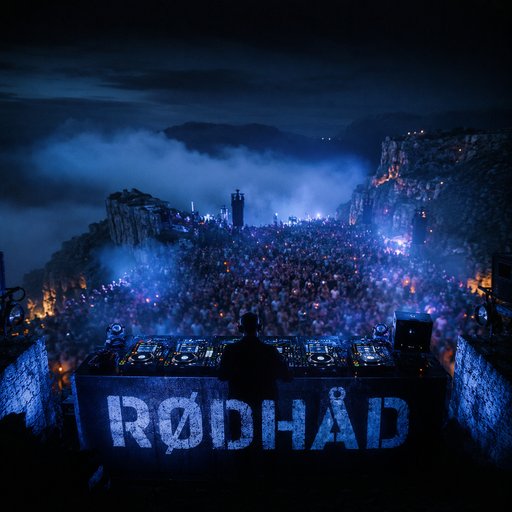
Rødhåd — Addicted Podcast #4
Melodic Techno · 1h 01m · analysed 20 Aug 2026 · source: soundcloud.com
Public mix analysis — no affiliation or endorsement. This report measures a publicly available recording hosted on soundcloud.com. The scores are produced by SOONOS and do not imply any partnership with, or approval by, Rødhåd.
In short
Addicted Podcast #4 by Rødhåd scores 74/100 in the SOONOS analysis (solid). The strongest dimension is TECHNIQUE (81/100) and the weakest is SURPRISE (69/100).
The engine files this performance as “Promising”.
Key takeaways
What weakened the set
- Recurring mid-frequency clash (2×) — Mid-range buildup muddies the soundstage and washes out vocals/synths during transitions. Detected 2× (18:24, 29:45).
- Long static loops (1×) — Sections sitting on the same loop without layering, EQ moves or tension shifts (19:15). Long loops kill dancefloor momentum.
What to try next
- Introduce melodic elements to break percussive monotony.
- Use longer breakdowns for more impactful energy shifts.
- Experiment with rapid cuts for more dynamic transitions.
- Introduce more varied transition techniques (e.g., short cuts or delay-based transitions) to add surprise.
Timestamped insights
Each moment below is tagged with how it was produced: “measured” comes from the DSP pass on the audio, “listening” comes from the multi-agent listening pass.
Smooth integration of new hat patterns over the existing groove.
Effective low-end handover, though the mid-range felt slightly crowded for 2 bars.
A bit abrupt; the energy shifted slightly too fast for the hypnotic flow.
Smooth transition with excellent low-end management; the new kick replaces the old one almost imperceptibly.
Solid blend, though the incoming track's mids are slightly dominant initially.
About this melodic techno set
Addicted Podcast #4 is a melodic techno DJ set by Rødhåd, running 1h 01m. It was measured by the SOONOS multi-agent engine and scores 74/100 overall — solid.
The engine files this performance as “Promising”.
How the score breaks down
SOONOS scores this set across 5 weighted categories. The strongest is TECHNIQUE at 81/100; the weakest is SURPRISE at 69/100.
Analysis coverage for this file is 100% — the share of the set the engine could measure with full confidence.
Energy and structure
The energy curve was sampled at 22 points, moving between 65 and 85 on the SOONOS energy scale — a moderate dynamic range across the set.
8 transitions were detected and scored individually.
Beat-grid measurement (DSP) reports 1034.4 grid breaks per hour, with a median beat offset of 25 ms.
How this score is built
Measured layer (DSP): the audio file is analysed directly — beat grid, tempo stability, loudness and energy. These values are measurements, not opinions.
Listening layer: a multi-agent pass reads musical intent — programming, storytelling, coherence and crowd effect. This layer interprets, it does not measure.
Fusion and ceilings: the two layers are merged, and the measured layer always wins on execution. When the DSP hears an execution problem, it caps the final score even if the listening layer is positive.
Measured coverage for this file is 100% of the set.
Full SOONOS analysis
The 8 dimensions
Not available — the 8-dimension profile was not measured for this set.
Score breakdown
TECHNIQUE
How well did you execute?
25%81
TECHNIQUE
How well did you execute?
STORYTELLING
Did the mix go somewhere?
25%77
STORYTELLING
Did the mix go somewhere?
ENERGY
Did you control the room?
20%73
ENERGY
Did you control the room?
SURPRISE
Did you remain unpredictable?
15%69
SURPRISE
Did you remain unpredictable?
IDENTITY
Did the mix sound like you?
15%78
IDENTITY
Did the mix sound like you?
Energy arc
Transitions analysed (8)
Perfect Blend
Minor EQ Overlap
Seamless Handover
Long percussive blend
Smooth integration of new hat patterns over the existing groove.
EQ-based swap
Effective low-end handover, though the mid-range felt slightly crowded for 2 bars.
Quick cut on phrase
A bit abrupt; the energy shifted slightly too fast for the hypnotic flow.
Long EQ blend
Smooth transition with excellent low-end management; the new kick replaces the old one almost imperceptibly.
Mid-frequency swap
Solid blend, though the incoming track's mids are slightly dominant initially.
Technical subscores
82
EQ balance
88
Beat alignment
79
Energy control
91
Tempo stability
83
Loudness control
81
Musical coherence
78
Harmonic compatibility
84
Transition cleanliness
Measured (DSP)
25 ms
Beat-grid drift (median)
Typical gap between the two tracks' beats while they play together. Lower is tighter.
240 ms
Drift p95
Worst-case drift: 95% of the set stays tighter than this value.
3,624
Boundaries detected
Points where the audio changes track or section.
70
Hard cuts / h
Abrupt track changes per hour, with no blend between the two records.
28
Clipping events
Moments where the recording hits the ceiling and distorts.
170
Level jumps
Sudden volume steps between tracks.
Measurement confidence 100% · analysed on the full audio.
Recurring patterns
Recurring mid-frequency clash
Mid-range buildup muddies the soundstage and washes out vocals/synths during transitions. Detected 2× (18:24, 29:45).
Long static loops (1×)
Sections sitting on the same loop without layering, EQ moves or tension shifts (19:15). Long loops kill dancefloor momentum.
Timeline
- 16:05Groove Lock
- 20:30Energy Plateau
- 22:45Risky pressure or vibe dip
Coaching notes
- Introduce melodic elements to break percussive monotony.
- Use longer breakdowns for more impactful energy shifts.
- Experiment with rapid cuts for more dynamic transitions.
- Introduce more varied transition techniques (e.g., short cuts or delay-based transitions) to add surprise.
- Layer in more non-rhythmic elements (drones, field recordings) to deepen the atmospheric immersion.
- Practice fading out the final track more gradually to avoid the 'abrupt stop' feeling.
Curious how your own set scores?
Methodology and limitations
This report is produced automatically from the published recording. It measures what is present in the audio file: a bad source encoding, a partial upload or a heavily processed broadcast version can change the measured values. Nothing here reflects the room, the crowd or the night itself.
Read the full SOONOS methodology →Questions about this analysis
- What score does Rødhåd's Addicted Podcast #4 get?
- Addicted Podcast #4 scores 74/100 in the SOONOS Mix Database (solid), based on audio measurement plus multi-agent listening.
- How long is Addicted Podcast #4?
- The analysed recording runs 1h 01m.
- Which part of the mix scores best?
- TECHNIQUE is the strongest category at 81/100, while SURPRISE is the lowest at 69/100.
- How is this score calculated?
- SOONOS measures the audio with a DSP pass (beat grid, loudness, tempo, energy) and runs a multi-agent listening pass on top. Measured axes always override the listening layer, so an execution issue heard in the file caps the final score.
More Rødhåd sets analysed
Similar melodic techno sets
- Solomun — Momentum Mix Oktober 202274
- Chris Avantgarde — Chris Avantgarde @ EDC Las Vegas 202574
- Anyma — Anyma | Argy | Adriatique | Vintage Culture (Melodic techno & progressive house set)74
- Ben Böhmer — Dj Zu @ Ben Bohmer live Krizikova Fontana Prague 25.7.202174
- Kevin de Vries — Kevin de Vries Support Set75
- Ben Böhmer — Ninja Tune Presents: Downtempo with Ben Böhmer (DJ Mix)73
- Pole Folder — Houtbaar Haarlem - July 202573
- Tale of Us — Tale Of Us - Live @ Time Warp 2016 (Mannheim) - 03-04-201675
Test how a set like this one would land in a club, a beach club or a festival.
Get the same breakdown on your own set: transitions, energy arc and measured execution.
Guides: How SOONOS works · DJ guides and research